Natas recipe: The taste from Portugal, baked at home

Natas recipe: The taste from Portugal, baked at home
If you’re a true Seabra’s Market customer, you know our Natas – or Custard Cups, whatever you call it, are a treat hard to beat. We’ve seen you at our aisles while grocery shopping, always stopping by our Bakery to get your own and have a taste from home through your favorite pastries.
Now, it’s time to kick it up a notch. Do you think you can bake a Nata as good as the one you find at Seabra’s Market? We’ll try to help you with this delicious recipe with products exclusively found at Newark’s #1 supermarket.
The origins of Natas

Natas, often called Pastéis de Nata, are one of the most famous Portuguese desserts: a small custard tarts with a crispy, flaky pastry shell and creamy egg custard filling. The story goes back more than 200 years and begins in a monastery in Lisbon.
The origins of Pastéis de Nata can be traced to the famous Jerónimos Monastery in the district of Belém in Lisbon, Portugal. During the eighteenth and early nineteenth centuries, monasteries and convents often produced sweets using large quantities of eggs.
Egg whites were commonly used for practical purposes such as starching clothing or clarifying wine, which left an abundance of unused egg yolks. Rather than wasting them, monks and nuns developed a variety of rich desserts made primarily from yolks and sugar. Among these creations was a custard tart that would later become known worldwide as Pastéis de Nata. The future of this dessert changed dramatically in the early nineteenth century.
In 1820, Portugal experienced the Liberal Revolution of 1820, which brought major political reforms and led to the closure of many monasteries and convents. As religious institutions began to lose financial support, the monks of Jerónimos Monastery looked for ways to survive. They began selling their custard tarts to the public through a nearby shop. The pastries quickly became popular among locals and visitors who traveled to Belém.
Easy recipe: Taste Portugal right at home

Pastry
- 1 sheet puff pastry (about 9 oz)
Custard filling
-
- 8 oz milk
- 4 oz heavy cream
- 5 oz sugar
- 4 egg yolks
- 1 oz flour or cornstarch
- 1 tsp vanilla extract
- 8 oz milk
- 1 strip lemon peel (optional)
- 1 cinnamon stick (optional)
For serving
- Ground cinnamon
- Powdered sugar
Instructions
- Preheat the oven
Heat your oven to 475–480°F (245–250°C). Very high heat helps create the classic browned top. - Prepare the pastry
- Roll the puff pastry into a tight log.
- Slice into 12 pieces.
- Place each piece in a muffin tin.
- Press the dough outward with your fingers to form thin pastry cups.
- Heat the milk mixture
- In a saucepan combine:
- 8 oz milk
- 4 oz cream
- lemon peel
- cinnamon stick
- 8 oz milk
- Heat until hot but not boiling.
- Mix the custard
In a bowl whisk:
- 5 oz sugar
- 1 oz flour or cornstarch
- 4 egg yolks
Slowly pour the hot milk mixture into the eggs while whisking.
- Thicken the custard
- Return the mixture to the saucepan.
- Cook on medium heat, stirring constantly until slightly thick.
- Remove lemon peel and cinnamon stick.
- Stir in vanilla.
- Fill the tarts
Pour custard into the pastry cups about ¾ full. - Bake
Bake for 10–15 minutes until the tops develop dark caramelized spots. - Serve
Let cool slightly and sprinkle with:
- cinnamon
- powdered sugar
Pro-tips from our Natas Specialists
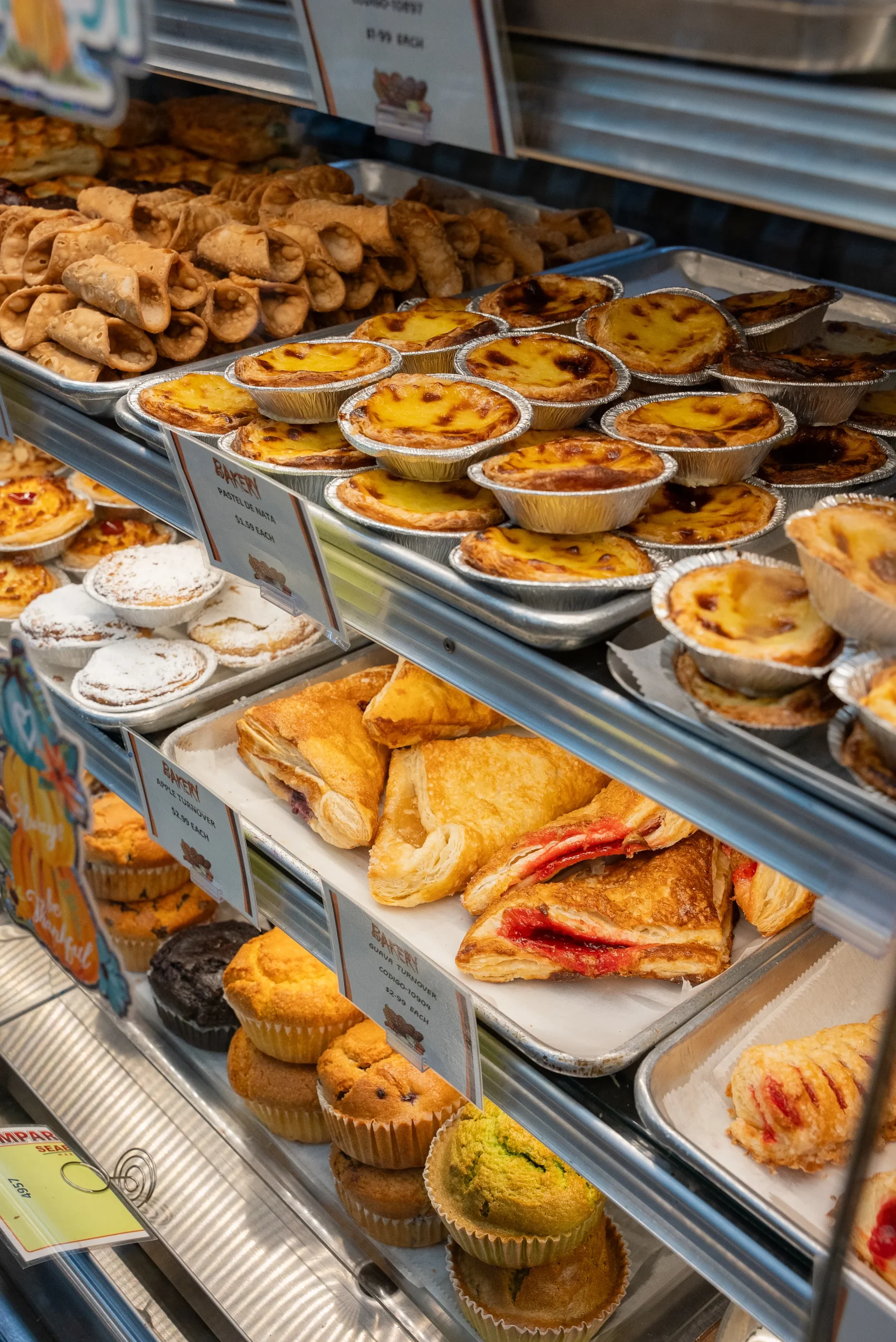
If you follow that recipe top to bottom, you’ll have 12 delicious tarts. If you really want to elevate your Natas experience, you should eat it warm and pair it with espresso or strong coffee. Also, you should bake at the highest temperature possible for the authentic caramelized top.